One of the most remarkable historical written sources concerning Norway is about Stjørdal ale. It was set down nearly 2,240 years ago, and has long since been lost. Yet it gives us a glimpse of everyday life in Stjørdal just after the Bronze Age.
We stretch matters a little when we claim this account for our own local history — to say nothing of the connection to brewing traditions that are still very much alive in Stjørdal in a way we find nowhere else in the country. But we don't stretch it so far that anyone can claim we are flatly mistaken. We have Fridtjof Nansen's word that it might just as well be that it was precisely in Stjørdal that the Greek Pytheas spent the winter 240 years before Christ, before going home to the city we know today as the French Marseille. At that time it was the Greek colony of Massalia.
Pytheas was a kind of combined explorer, merchant, diplomat and writer. He had no doubt long had a furious itch to visit the country of the Celts, who kept coming to Massalia with metals and other goods to trade. But Pytheas could not travel by sea, because the Phoenicians blockaded the Strait of Gibraltar against the Greeks. The Phoenicians wanted control of the trade themselves.
But in the very year 240 BC, the Phoenicians were chased off by the Romans, who took over control of shipping in the area. Pytheas could now at once fit out a ship, probably of the standard size of around 100 tonnes and with a crew of 20–30. He knew that a successful trading voyage would be good business, for the people of Massalia had plenty of money and needed many goods, not least tin and copper for bronze production.
Navigated by the stars
Pytheas's later account of the journey shows that he was himself well versed in the stars, and navigated by the small bright dots in the night sky. He must have been a little surprised to discover that the voyage round Spain brought him to the same latitude as his home city of Massalia. Therefore Spain must be a peninsula.
No less surprised, surely, were Pytheas and his crew when the days grew longer and the nights shorter the further north they came. From the Mediterranean they had very limited experience of summer days lasting so long.
We know nothing of what kind of contact Pytheas & Co. had with the French. They may have been treated to both red wine and baguettes, but if so, that was nowhere near as exciting as the gastronomic experience that awaited them much further north.
The voyage went on, and Pytheas at last reached the realm of the Celts, where today we find Cornwall. He apparently had a fine time there and met agreeable people. But the weather was bad, and the Greek was twitching with wanderlust. The ship could take a rough sea, and he had to see more of the world now that he had come so far!
Most likely he sailed northwards through the Irish Sea, and on to Shetland. Along the way he no doubt picked up reports that there was even more to see still further north. There lay Ultima Thule, the world's end.
Sun day and night
Pytheas later wrote that he really did reach Ultima Thule, which he said was "six days' voyage north of Britain" — but was it Iceland, Greenland, or perhaps the Faroe Islands? Pytheas reported a sun that shone day and night, and that the sea had apparently turned into a kind of porridge that flowed together with the sky.
Autumn drew on, and Pytheas wisely concluded that it was best to find a place to overwinter. He really did find one, and it is here that things start to get truly exciting for the people of Stjørdal.
Pytheas, as mentioned, was well acquainted with the heavenly bodies, and during his winter stay he kept careful notes on the course of the sun and moon, the stars above him, and the tides. He also described the natural surroundings, and gave the travel time to the wintering place. These notes were much later analysed by another great explorer, namely Fridtjof Nansen, in his book In Northern Mists (published 1911). Nansen concluded from the information that Pytheas had overwintered in Norway, at a place that must lie between Møre in the south and Helgeland in the north.
In the middle of this stretch lies the entrance to the Trondheimsfjord. So it is most likely that it was in here that Pytheas sailed in search of a wintering place. And once he had chosen the Trondheimsfjord, he naturally sailed straight up the fjord until he saw inhabited land directly over the bow of his trading ship. That can only have been Stjørdal — already at that time long since permanently settled, and which right up to the end of the Viking Age was the most important centre in the lower Trøndelag region (Uttrøndelag).
So we have neatly parked Pytheas and his men in Stjørdal, and we shall now bring forward yet another argument that makes this theory plausible.
"Cheered their minds"
In the book Pytheas wrote after returning home to Massalia, he told that during his winter stay he met "a people who made a drink from water, grain and honey, with which they cheered their minds".
Anyone who knows a little about brewing realises at once that this drink was, quite simply, beer! The old Norsemen had thus already learned the art 2,300 years ago. Both the information about beer and my impudent claim that he was in Stjørdal may very well be correct.
For we know from other, entirely reliable sources, that beer was being brewed in other parts of the world long before this. The first to do so were perhaps the people of Mesopotamia, 6,000 years ago — the country we know today as Iraq. Researchers hold that as soon as people settled and began to grow grain, they also began to brew beer. Some go so far as to claim that they began to grow grain not in order to bake bread, but precisely in order to "cheer their minds" with beer. If so, beer was the reason people gave up the nomadic life. In Mesopotamia, grain cultivation began around 6,000 years ago.
And in Stjørdal it began 3,000 years ago — many hundreds of years before Pytheas came calling! The very first cornfield perhaps lay somewhere in Skatval, close to where Sandberg's market garden now stands. That area lay then down at the water's edge, and was excellently suited to grain cultivation.
Historical knowledge from other parts of the world makes it likely that with the grain came also, before long, the first drops of Stjørdal ale, already a thousand years before Christ. After a few hundred years' development of the art of brewing, the old Stjørdal folk were probably able to entertain Pytheas and his wine-accustomed men with drink as good as today's local brewers still produce.
Laughed at in Massalia
Poor Pytheas — he was nearly laughed out of town when he got home to Massalia and told of the sun that never set in summer and never rose in winter. His countrymen thought he must have lost his wits, and people shrugged at the incredible reports in his book On the Ocean. What a strange imagination on that fellow!
Yet some of the scholars of his day did take an interest. They found that Pytheas had a number of observations in the book that they themselves could confirm — and so they were the more inclined to believe the rest of what he said.
Pytheas's own account has long since been lost. But large parts of his story were later retold piece by piece by other ancient writers. In our own day, historians have gathered some of these pieces so that the journey has become known.
And therefore we know, almost for certain, that the people of Stjørdal have raised their glasses of home brew for at least 2,300 years. Now isn't that worth a toast?
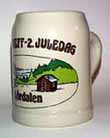
he does not spare his guests a fine drink,
he pours with cheer — that is a goodly way,
and so he deserves both honour and praise."
— Inscription on a beer bowl
thirst for ale, night-walking,
card-games (ed.: trumpeslagtt) and whoring
have ruined many a fine fellow."
— Beer-bowl inscription from 1614, of eternal validity
— Bergens Rimkrønike, 16th century
— Saying from Strinda
— Beer-bowl inscription from 1776
— Curate Børre Henrich Rachløw on a Stjørdal bridal pair, 1769
— Saint Martin of Tours, in a vision to the king in the saga of Olav Tryggvason
of malt and plenty of hops;
here the ale is drunk down,
so that many a one must tumble."
— Inscription on a beer bowl
— Tolstoy in his book Why people drug themselves, 1891