Throughout the ages, certain aromatic plants have been used in the brewing of beer. We may begin with the conditions in the time of Christian IV. In those days the brewing of malt beer was very widespread in all parts of Norway and Denmark.
In a very large flora and medical book written by Christian IV's personal physician, printed in 1648, there is also a great deal of information on the properties and uses of herbs. On page 845, for example, it says of mugwort (Graae Bynke), the close relative of wormwood (malurt): "In some places in Norway it is used to lay upon the rost when one brews, in order to make the beer strong." Both kinds of growth give off so harsh and bitter a taste that one had to be careful with the strength, lest there be too much bitter wormwood in the cup.
When in olden times it was reckoned up "what virtues the beer should have", the answers were often "a good colour, smell and taste". So it was noted down and printed in Christian IV's day.
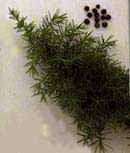
In the Norsk historisk leksikon for the period 1500 to 1850 (printed in Oslo/Gjøvik 1975), the entry "brygging" (brewing) records: "As flavourings in beer, in addition to juniper, were used, among others, hops (the female flowers), bog myrtle, yarrow, tansy and caraway." For home-brewed malt beer, it is still permitted to use bog myrtle and hops in the production. The other plants were unfortunately "defined out" when the Beer Act of 1912 came into force.
Caraway export
Here in Norway the new regulations chiefly affected caraway production and the use of caraway. Apart from a high domestic consumption, before the turn of the last century there was a fairly large export of caraway. Whether merely steeped in water, or in the form of caraway-water in small beer, drinks with caraway flavour were a popular commodity. It was one of the most widespread thirst-quenchers for several hundred years. Even after the very last drops of alcohol had been drawn from the mash tun, there was much mash, smoke and malt-flavour left. With a fresh addition of boiled water, juniper, and caraway-water, one could afterwards draw off the loveliest thirst-quencher, well coloured and with good keeping quality.
Sometimes the drink was sweetened, partly with syrup or with the lye from meadowsweet leaves. This was mainly from the third drawing-off of the malt. "Spidsøl" was what this thin beer was often called in olden days, but it was also frequently used as a thirst-quencher during haymaking and harvesting work, work-bees and the like. Such beer was also often called "munngodt". With meadowsweet leaves as supplier of sugar, taste and smell, such thin beer received favourable mention from Bishop Gunnerus and the parson Wilse some 225 years ago. Such thin beer was still much used in my childhood 60–70 years ago.
Most was heard of the strong malt beer, and of the beer that was produced from the first and second drawings-off of the mash. Very many people then made use of herbs from their immediate surroundings to enrich the beer.
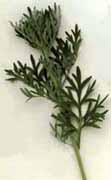
In olden times, distinctive names were often given to plants that were to be used for particular things, and where it was important to avoid mix-ups and unnecessary dangers. So too, no doubt, arose the terms "ølkonge" (beer-king) and "ølkall" (beer-fellow). It is interesting to note that local differences arose in what was held to be best. In the Stjørdal districts, for example, tansy has been beer-king number one, while in Verdal and large parts of the rest of Innherred, the thousand-leafed yarrow has stood at the top of the list, partly as beer-king, but most often as the important beer-fellow. People who moved from Verdal to Stjørdalen or vice versa thus often had two kings to wrestle with. That too went well, for in both places these two flavouring plants were to be on the rost.
From time immemorial, herbs have been part of the wort, and part of the strainer through which the wort would run down to the vat where the yeast was to be added — what we call the rost. Where there is alder forest with St John's wort growing in it, one preferably uses staves of freshly cut alder, with or without bark. Tarnished alder staves give a fine colour to the beer. The old people also held that the beer was more durable when alder was used. The alder pieces were used to build up what is also here called the rost. Juniper, straw, beer-kings and beer-fellows took their place there to watch over the beer. The matter was no doubt that they were to give off taste, smell, nourishment and preservatives to the wort-beer and to the liquid that ran through from the wort vat to the yeast vat. If there was an artificially perforated grate for the straining, the beer-kings could be placed both above and below the rost. In certain places, including Skatval, caraway was gathered, and the long stiff caraway stalks were often laid by the rost to give off a flavouring of spice.
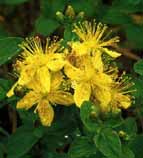
The beer-king St John's wort (perikum)
Prof. Hornemann (1821) has, in his Plantelære, the following on St John's wort (perikum): "The flower-buds are used in some places in Norway for tea, and here for adding to brandy." And then, perhaps the most important: "The whole plant is used in some places to lay upon the rost in order to make the beer clear." Hornemann and his book had close ties with the veterinarians and others who studied in Copenhagen, of whom many were spread throughout Norway. There was thus also a little book-learning behind the folk memory of beer. In Sunnmøre the plant was also called beer-king a hundred years ago.
Very many of the spice-bearing plant parts used in beer brewing contain bitter substances and fragrant essential oils. They are easily released into the surrounding liquid. The bitter substances are water-soluble and give a sharp taste which at the same time helps regulate increased keeping quality and natural storage life. From bog myrtle, antibiotic substances also come along.
Each herb contributes its own particular colours to the drink that is made. Tansy contributes more yellow colour to the beer, while caraway gives a pale brown shade. The yellow-flowered, dot-leaved St John's wort was earlier often used as a colour regulator, and the product then takes on a fine reddish-brown colour with a distinctive taste. In certain parts of the country, St John's wort is still one of our beer-kings. The plant also contains tannins, and was used in tanning.
On the beer-king yarrow
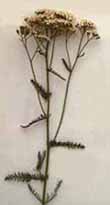
Yarrow is named as a very frequent flavouring in the production of beer. At nearly all the old drying houses or their sites that I have visited in different parts of the country, this plant was to be found. The flowers are white, gathered in an umbel. The foliage is distinctive, with many small leaves up the leaf-stalk — it is therefore often called "tusenbladet" (the thousand-leafed). As to names, yarrow was called Ølkong in Grong, Høylandet, Inderøy, Mosvik, Skogn, Spabu and Vemundvik.
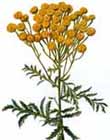
Who does not know tansy with its fern-like leaves and stiff stems with yellow flowers in an umbel? All parts of the plant have an aromatic scent. The flower-head is known for keeping its yellow, golden colour on drying. Hornemann (1821) has it: "In some places in Norway it is laid under the rost to make the beer strong and bitter."
According to Høeg's gathering of names (1974), tansy was called beer-king in Eikefjord, Jølster, Naustdal, Selbu, Hegra and Skatval. To the list may be added the neighbouring villages of Lånke and Stjørdal, according to my own experience and conversations with old folk. The name "ølkallmann" was recorded from Leksvik. Hegra and the other Stjørdal villages largely make up the area in which generation after generation has brewed Stjørdal ale. The area broadly coincides with the use of the beer-kings tansy and thousand-leafed yarrow.
Other beer-fellows
The names "ølkall" or "ølkong" occur for several plant species. For the area north of Dovre, Bishop Gunnerus (1766) noted that the ølkall name was used in Innherred for the genus Prunella, with the species selfheal (blåkoll). The perennial and beautiful Origanum vulgare — which in our day has again become so well known for its spicy taste, smell and lovely flowers — has also been used for beer. It supplies the pizza spice oregano, and is also called "kong". Hornemann (1821) wrote: "Likewise are some of them used for adding to beer, in order to prevent it from going sour." Mountain-king oregano is a honey-bearing plant. In some places in Norway, the lovely yellow-flowered Arnica montana has been called ølkall or ølkong — they are now usually called solblom in this country.
Meadowsweet as Christmas-grass
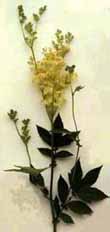
When O.A. Høeg gathered plant names on a country-wide scale, he received reports for the sweet-smelling meadowsweet under the name "julgras" (Christmas-grass) from four parishes: Stadsbygd, Frosta, Leksvik, Lånke. He links the name with the fact that the raw material was probably used in beer brewing for Christmas. The rule was that such "grass" for beer brewing was to be harvested before Midsummer (St John's Day) and safely stored for autumn and winter use.
Meadowsweet was for long an important resource for people and livestock, not least in times of shortage of sugar, grain and malt. The content of sugar, juice and vitamins is high. The plant's constituents combine well with the substances obtained in malt-beer brewing, and then perhaps especially as small beer.
Use from far back
The above shows that herbs as beer-fellows, beer-kings and beer-grass on the rost have been used from very far back. The same no doubt holds for the spice-bouquet that was "set on" or "hung in" the beer barrel during brewing. A pouch of various spice-herbs — preferably with thyme, tansy, sweet basil ("hjertensfryd"), St John's wort, caraway and so on, along with a small stone and a string up through the bung-hole — meant that the whole could be regulated up and down in the barrel and impart a fine flavour.
The first time I took part in brewing with such herbs at the rost and in the beer barrel was at Christmas 1928. It made a good and lasting Stjørdal ale. The non-alcoholic wort tasted excellent too. Most of the answers about beer-kings and beer-fellows came in from informants in the various villages in the years between 1930 and 1940. They show that such names were particularly common in Trøndelag still some 50–60 years ago. In the great majority of recipes for Stjørdal ale, Voss ale, Sogn ale and so on written down in our own time, herbs other than hops are scarcely mentioned. The experiences of the older generations are being forgotten. Do the spice-herbs and their constituents deserve such a fate?
The author of this article, Gunnar Weisæth, was born at Reppe in Stjørdal in May 1915. Until the autumn of 1937 he went through apprenticeship, agricultural school and horticultural school in Trøndelag, and then attended the Norwegian College of Agriculture (Norges Landbrukshøgskole). He was a combat soldier with IR 12 and IR 5 during the war in the spring of 1940, and was wounded in the fighting in Østerdalen. In the years 1941–1945 he was assistant gardener at the University Botanical Garden in Oslo. From December 1948 to 1956 he was a researcher and teacher in South America, most of the time at the University of Tucumán in Argentina. Later he was a researcher and teacher in vegetable cultivation at the Norwegian College of Agriculture until retirement age.
— The oldest known text about beer, ca. 8,000 years old. Found on a clay tablet in Sumer (in present-day Iraq)
— Odin in the old Edda
— Dairy farmer and brewer Christian Schou (1860). ("Mask" is malt after the brewing.)