Hops and bog myrtle have such properties that to some extent they can replace each other in the production of home-brewed beer. Best, however, is when hops and bog myrtle are used alongside each other. Both growths contain bitter substances, resin, tannic acid and essential oils. They thereby influence taste, keeping quality, scent and so on, and contribute to the precipitation of protein matter in the beer. Both also contain colouring substances which transfer easily to the wort and to the fermented liquid that is malt beer.
Hops
The hop plant consists of long, self-climbing tendrils, often 5–6 metres long. In the upper part of these grow many cone-like fruits, the so-called hop-cups. When fully developed, they are usually 3–5 cm long. With the help of a magnifying glass one can see, at the bottom of each scale, yellow-coloured, glistening glandular hairs. These are the chief producers of the valuable substances Lupulin and Humulone, both of which give a great deal of bitterness to beer and the like.
If one takes some hop-cones and lets them lie on white paper for a few days, one will see a great deal of yellow-coloured powder fall down from them. After drying as a drug, this product is called Glandula Lupuli, or hop-bitter. The powder is so finely scattered that a great deal of it can collect at the bottom of the bags used for harvesting and storage. Therefore turn the container thoroughly when emptying the hops.
What quantity of hops should one add to beer of varying strength? Looking at the recipes for beer collected in the book Norsk mat (1965, Cappelen Publishers), one sees that for Stjørdal ale 3 hg of hops is given per 80 kg of malt or 100 litres of finished beer. For Voss ale, 5 hg is given for 100–120 litres of finished beer. Otherwise it varies from a few hundred grams to nearly 1 kg of hops per 100 litres.
By using bog myrtle, tansy, yarrow and other beer-herbs, one could spare some of the quantity of dried hop-cones.
Bog myrtle contains many substances that have a roughly similar effect to hops. Until 100 years ago, the leaves and twigs of bog myrtle were an important flavouring in the brewing of beer. That bog myrtle was still permitted in the Beer Act of 1912 in the production of home-brewed beer was no doubt due to its still being seen as an important resource for people and country. Many years' experience from my own hop garden has shown that, every now and then, the hop crop can be ruined by frost, mildew, aphids and the like. By keeping up a knowledge of bog myrtle, one can supplement with this if it should ever become difficult to obtain hops privately.
We have at present no commercial hop cultivation for sale in this country, and are therefore dependent on the world market. The breweries the world over are the first to secure their hops. From olden times it was not allowed to gather twigs and leaves of the bog myrtle plant before St Olav's Day, 29 July. This was laid down by law. By following this rule one will perhaps avoid the unpleasantness which sometimes appeared after use of strong bog-myrtle beer. For a long time, at any rate, it was held that one should not brew beer using twigs of bog myrtle bearing flowering shoots.
The flowering of bog myrtle is in early spring, usually in April and the first part of May. In this period the plant gives off a very strong smell that can be detected at a great distance. The plants then have a different metabolism than at other times, and this presumably affects their constituents and their internal balance and effect. Fortunately, several people in Norway are now investigating this.
Bog myrtle
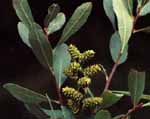
The bog myrtle plant has bogs and the edges of small lakes as its main habitat. The plants are bush-like, up to 1 metre high. Bog myrtle leaves were for many years an important flavouring for people throughout the country. They were, for example, ground into home-made sausages, by which they presumably gained better keeping quality. The leaves were also used for tea, which apart from a good flavour takes on a fine green-yellow colour. They contribute the same colour to malt beer. Bog myrtle leaves were also a soup spice, not least in meat soups.
In our day, bog myrtle is perhaps best known for its good smell and evergreen leaves. It is on the way back as a green plant for house, garden and parks. So long as the outdoor privy was the rule, there was hardly an outhouse without one or more hanging bunches of bog myrtle, which gave off their refreshing scent for long periods. The old folk held that bog myrtle in the bedstraw kept the fleas away, and likewise the mosquitoes. Bog myrtle was one of the useful plants that did best in the fight against moths in clothes and yarn.
It is long since malt beer was brewed with bog myrtle as the chief contributor of taste, smell, keeping quality and colour. Measures for how much bog myrtle should go per malt-sack or 100 litres of beer are therefore hard to find, but a practical measure is twigs amounting to a hand-held bouquet. One might try, for a start, with 1–2 such bog-myrtle bouquets.
The author of this article, Gunnar Weisæth, was born at Reppe in Stjørdal in May 1915. Until the autumn of 1937 he went through apprenticeship, agricultural school and horticultural school in Trøndelag, and then attended the Norwegian College of Agriculture. He was a combat soldier with IR 12 and IR 5 during the war in the spring of 1940, and was wounded in the fighting in Østerdalen. In the years 1941–1945 he was assistant gardener at the University Botanical Garden in Oslo. From December 1948 to 1956 he was a researcher and teacher in South America, most of the time at the University of Tucumán in Argentina. Later he was a researcher and teacher in vegetable cultivation at the Norwegian College of Agriculture until retirement age.
— Letter of thanks from the Tsar's court in St Petersburg, ca. 1880, after a consignment from Le Coq's brewery in England
— Saying from Setesdalen
— Saying from Romsdal, 1740