— It has been the custom on this farm that the beer must be of home-grown grain, says Edvard Langeland, the young farmer of Utigard at Faleide, just west of Stryn. For two days he has followed the progress of the brew with keen attention. Lifted the cloth over the fermenting vat (gilen), and rejoiced at the soft glugging sounds and the scent of yeast spreading between the walls.
— It is a lot of work, but it is well worth the effort, he says, and fills the bowl again.
"I stand before thee, both red and blue, as a warrior with his weapon! 1848" — so reads the careful inscription around the rim. Countless lips over a hundred and fifty years have not managed to wear away either text or colours. The men of Utigard, Midtigard and Inigard nod with satisfaction as the Christmas Eve bowl at Utigard passes from hand to hand and from lip to lip. They smack and drink for as long as their breath holds, and wipe yeast-foam from their lips.
Anders Øen has taken part in many a brewing both here at the home farm and in other places. He knows the traditions from the time when people were self-sufficient in everything.
— The best malting time was April–May, he says. By tradition, brewing was women's work. The men took care of the drinking. The best malt was had when the shoot had grown two-thirds up through the grain. If the shoot grew too long, the strength was gone. Mould during drying was dangerous — especially the white kind. That gave you spew-ale.
Anders speaks easily while the work follows old rhythms. The juniper lye (einelog) simmers and boils. A few of the men ladle it over the fermenting vat and the wort-tub (rusten) so that everything is properly clean. After an hour of boiling, the mashing can begin.
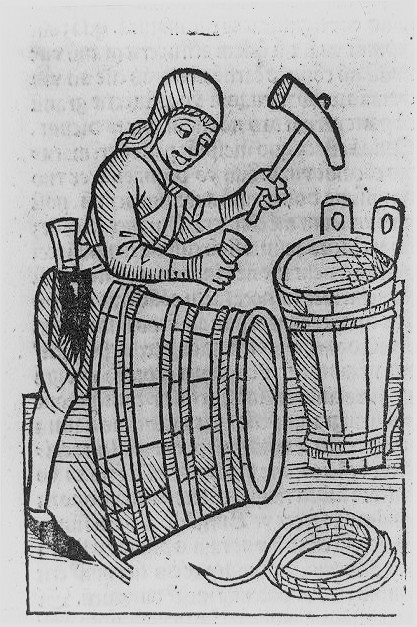
— I usually mash for a couple of hours. The first hour I keep it fairly thick, but then I top up with more juniper lye. It is important that it is not too hot. It should not go above 70 degrees. Then it binds the sweet substance, he says, while the fine scent of sweet grain and juniper lye stirs taste and sense of smell.
And then the mashing is over. Anders lifts the mash paddle and sees that it drips from the edge. The old men used that as a sign that the wort would run well.
The wort-tub is ready. At Utigard they have a perforated bottom (rustebotn) — easier than laying down a strainer of juniper twigs at the bottom. Some use alder sticks. Above the strainer one lays juniper berries, and then ladles the mash over.
— The first bucket you draw off, you pour back over the rost. It must run properly clear before you start filling the gil.
Knives against evil spirits
— We had better do as Jakob Anders did. He set knives, blades down, in the rost. That stopped evil spirits from blocking the run, laughs Anders, and goes off in search of a knife.
— Jakob Anders also kept knives on his chest. He was usually a God-fearing man, but when the old sheriff asked him why, he answered that no one was going to cast kag (witchcraft) on the beer when he was brewing.
Edvard of Utigard knows the tales the old folk told. We did not go so far as to splash the first drops from the rost across the floor and in the doorway, but old stories come easily while the foam grows in the gil. For every wooden bucket that fills up, a notch is cut in a stick to record the progress. Even though one keeps an eye on the sweetness of the taste, it is important to keep count of the litres.
— In winter it is not so dangerous, but to be safe we use a few handfuls of hops in the mash. The hops are important for the flavour, but they also keep the beer from turning sour.
"Mariauga" and the holy night
"Mariauga" — Mary's eye — is set in a wooden bucket. The yeast is dissolved in a few litres of the wort. It must come into life before it goes into the fermenting vat. The name harks back to the Virgin Mary, and the fact that beer brewing was a sacred act.
— On the holy night — Christmas night — they were also to brew. Fines or banishment awaited those who did not keep the commandment, says the Gulating Law.
— We won't dwell on all the things they said about witchcraft, but in the same way as with pig-slaughter, the old men wanted to brew at flood tide and waxing moon. Anders has long experience as the village butcher. In the days when there was a Christmas pig on most farms, he was little in demand at the waxing moon, but at the waning moon he could work double days. They believed the pork went further then.
The last act of the brewing, before the yeast is set at the right temperature, is the hop-decoction. A package of hops is boiled for an hour in 15–20 litres of the wort. Anders is careful to leave the lid off — the hop-decoction must air out properly during boiling. Some pitch the yeast at nearly 34 degrees. Others want the temperature below 30. It is a question of habit, and what the yeast is used to. Those who tend their yeast properly may keep it for generations. It is said that the yeast culture at Hansa Brewery comes from Oppstryn. Doctor Sopp once stated that the people of Nordfjord had the cleanest yeast in the country.
We take our leave of the brewing as the first plops sound under the cloth over the gil. We tiptoe quietly out the door.
— Don't disturb the yeast as you pass, or the beer will turn out poorly! the old folk used to say, who took off their wooden clogs and walked softly past the doors until the beer was safe in the bowl.
The recipe for Stryn ale
Either ready-made malt, or your own grain that you steep, sprout and dry yourself. Coarsely mill the grain the day before brewing.
Brewing day begins with boiling juniper lye and cleaning the gil and rost. Steep the grain in the gil (a wooden vat that holds a couple of hundred litres) with good juniper lye that is not over 70 degrees (mashing).
After two hours, ladle it over into the rost, where you have laid a strainer of juniper twigs or alder at the bottom. Ladle juniper lye over before you start drawing off. Draw off slowly to bring along all the sweetness.
Towards the end you take off some of the wort to boil the hops. For a brew of 50 kilos of malt, you use half a kilo of hops. The hop-decoction is boiled for at least an hour, and many cool it before mixing it with the wort.
Between 30 and 33 degrees you pour the Mariauga into the gil, and the fermentation is under way. Some also add a little candy sugar to get a stronger beer — that is a breach of the old brewing art.
— The Swedish travel-writer Abraham Hülphers on preparations for a wedding in Leksand in Dalarna. With 400 guests (half of each sex), this came to 1.4 tonnes of malt — enough for at least 4,000 litres of beer, or ten litres per head. On average…
Considering how old the malt-beer tradition is, the more professional brewing industry in this country is fairly young. Not until 1776 was the first beer brewery established in Christiania, and it produced for ships' crews. Twenty-five years later came the first breweries that made beer for ordinary citizens.
Before that time, all beer was home-brewed by medieval methods — as today's malt-beer brewers in fact still do it, at least in Stjørdal. In 1857 there were no fewer than 343 breweries in Norway, not least because the authorities encouraged the sale of beer to stem the steadily increasing abuse of spirits.
And we who thought that southerners only drank coffee, both at home on the porch and in the white prayer house. That is apparently not so, if we are to believe statistics from the Norwegian Directorate of Substance Abuse. Kragerø is in fact the no. 1 beer municipality in the country. Here, beer is bought to the value of 6,000 kroner per inhabitant per year, while the national average is 2,200 kroner. There are 5,800 inhabitants over 18 in Kragerø, and beer is sold for 33 million kroner.
But a substantial part of the picture is no doubt the very many summer visitors, who feel that beer goes well precisely in such surroundings and during leisure time. Moreover, Kragerø did not have a Vinmonopol outlet before 1992, so consumption of wine and spirits has been less than in other parts of the country.
If, that is, one is to believe the official statistics. And one cannot really, in these days of home distilling and smuggling.