The foundations of beer are malt, yeast, hops and water. The beer shall be made from home-produced malt, and malting followed by drying is the craft of brewing. It is the malt that gives the beer its flavour and character.
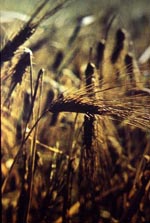
In earlier times both wheat and barley were used. Today in the Stjørdal valley only barley is used for malting. Older brewers swore by "Maskinbygg" — an old six-row variety with a strong tendency to germinate — for good results. Today two-row barley is widely used, but the newer varieties require careful thought because of their germination-resistance. Hognesaunet Såinnhuslag is currently trialling Finnish barley varieties specially developed for malt production.
Grain intended for malt must be fully ripe and have a high germination rate, ideally 96–100%. The grain is best cleaned to remove damaged kernels and to achieve an even size-grading, which in turn gives even germination. Grain with a high starch content is preferable. Each individual maltster doubtless has their preferred varieties, but any grain can be used.
The old varieties were not bred for high germination resistance. Once the grain had been cut and set up on stooks, sprouting on the stalk was avoided. Today the grain may sprout on the stalk in years with poor harvesting weather, when it is not possible to combine-harvest at the right time. The varieties developed in recent years have been bred to be germination-resistant. The disadvantage of this for malting is that germination performance in the harvest year is very poor at high temperatures. It is therefore not advisable to use germination-resistant varieties until the grain has been stored through to the following season — that is, over the summer. The after-ripening that takes place reduces the resistance and increases the germination rate.
The quantity of grain normally used in the Stjørdal valley for a single malting is 150–200 kg, depending on how much goes onto the såinn and into the germination frame. The grain is steeped for approximately three days in running cold water. The grain absorbs (swells with) about 40% water.
Germination brings major changes to the barley kernel. It becomes tender, and the cell walls between the starch granules break down. The starch in the grain is broken down and converted into simple sugars. Germination also develops enzymes, including one called amylase. During brewing this enzyme converts the malt's insoluble starch into sugar and other water-soluble substances.
After steeping, the grain is laid in the germination frame. This can vary in size and shape; I use a frame measuring 1 × 3.5 m and 20 cm deep. The grain is spread in the frame and covered with damp hessian sacks. Some maltsters pile the wet grain into a heap in the frame and cover it with sacks.
After about a day the grain begins to "heat up". The grain is then gradually mixed and spread out in the frame for continued germination. This method can take about a day less, owing to the higher temperature. After one to two days the rootlets begin to appear.
Some maltsters leave the grain undisturbed during germination. The sacks covering the grain are kept damp but the grain itself is not turned. Others, however, turn the germinating grain at least once a day.
Germination produces carbon dioxide and heat, and you can feel very clearly in the grain when germination is under way. It takes five to eight days, depending on the temperature. A suitable temperature in the cooler season is 10–12°C. When the rootlet is about 1.5 times the length of the grain, or the leaf-shoot is 2/3–3/4 of the grain's length under the husk, germination is complete. In a handful of germinating grain you will find five to six "åla" (leaf-shoots).
For those who leave the grain undisturbed during germination, separating the mass afterwards is a time-consuming job. The whole germination frame is like a large cake, and it takes several hours to pull it apart.
When germination is complete, the grain has become malt — not yet ready to use in brewing, but ready to be dried. Drying must both halt the germination process and make the malt storable, while also giving it the flavour and aroma that the beer will receive during the brewing process.
— Norvald Tveit (1986)
"Grain with high germination resistance normally has a high germination rate at low germination temperature, while high germination temperature gives a low germination percentage. If the grain is stored over the summer, the biochemical block is lifted."

— The Ministry of Finance, 1858

— The Gulathing Law
"To economise on their grain stores, the people of Sund brew beer only twice a year, namely for Plough Monday and for the Christmas season."
— Gerhard Schønning, 1773–75